The tip of the ICEberg #2. Drawing maps and taking blocks.
[written in February and March 2026] Thoughts and reflections written through the siege.
For full context and caveats for this series, see post #1.
I don't know where we go from here. I'm barely able to grasp where we've been in the last few months. I know I have to accept it will politically be a two steps forward, one step back kinda thing. We'll never be the same. I don't mean that we'll never be the same in some ethereal, rose-tinted glasses way. It is a feeling, but it's not just a feeling.
Some of this can be tracked in real time. The systems created to communicate across the tens of thousands of people responding to ICE daily are constantly evolving. As the tactics of whistles and direct observation and confrontation continue, new and creative tactics are emerging as well. One of these is the block party.
Before I dive into this tactical evolution, I want to say that it has been a long time since there were so many drawn maps in my life. I've lost count the number of times in recent memory where sitting across a table of people, a hand-drawn map was presented or created. I'm just old enough to have come up in a time where this once was a normal way to help someone with directions - before smartphones and Google maps. So, admittedly, it holds a warm nostalgia for me. But more than that, it was a quick shift away from our invasive and hyper-tracking technology in order to share about locations or dream up ideas. One trajectory of this was to re-imagine the neighborhood block.
~
A thing to know about ICE in Operation Metro Surge is that they raced in their ever-rotating fleet of unmarked rental cars down our streets at dangerous speeds (i.e 70mph+ in a 30, ignoring crosswalks). They zoomed in and out of neighborhoods as they pleased. Responding to them, even in all the headlined glory that was sold above the fold, was never enough to completely prevent them from taking people. While we didn't abandon the whistles and swarming that sometimes did work, there were ongoing creative ideas to find further tactics.
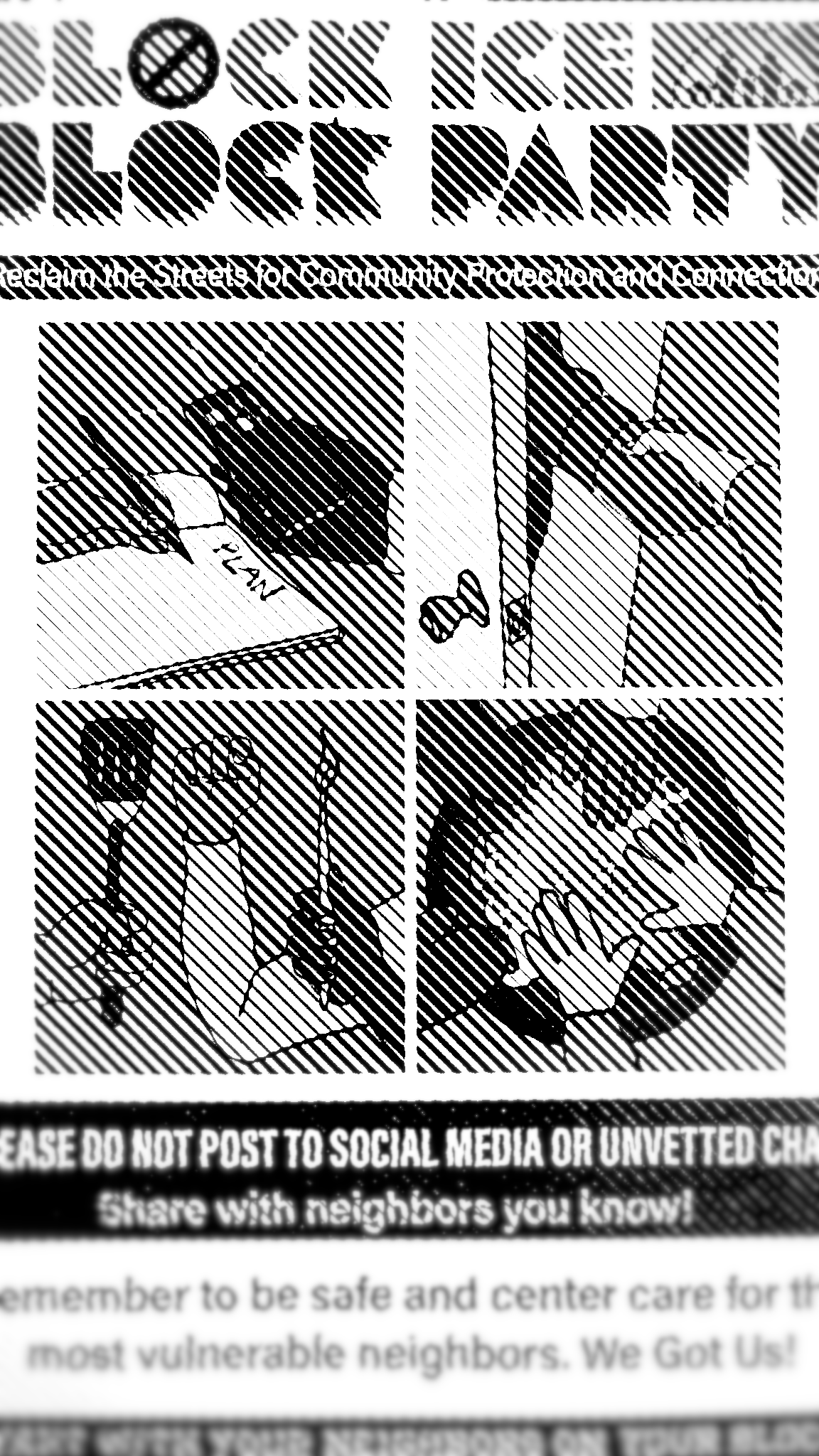
The the block party had two primary goals. One, slow down traffic and a have better idea of who was coming in and out of the neighborhood. Neighbors are welcome, ICE/cops/sheriffs are not. They couldn't be stopped but there was always a need for more eyes on them. And, it slowed them down. So, usually, for a party, little round-abouts were created in intersections
Second, it gets fucking cold in Minneapolis in the Winter. So, gathering together is difficult. A precursor/parallel in some areas to the block parties were front yard fires. These were places that made it easier to be out on watch where neighbors could gather around some warmth. When the block parties started, they often were centered around not only a makeshift round-about but one with a fire going. Thus, the space became a place to gather and feel close to neighbors. People would bring out food, art making, music, signs, and all kinds of things. It was hub of joy in a cold and harsh winter.
The idea here is rather simple but its trajectory is important. The idea emerged on seemingly magical, almost simultaneous timelines in a few areas of the city. They were not all the exact same in their imagining but pretty damn similar. I heard a story about a conversation that took place in that emergent moment. A group of neighbors was discussing this idea and beginning to plan a party. One member of the group - a more liberal, older, white man - expressed strong concerns at the idea. He was worried that this was provoking ICE/the cops and would lead to already vulnerable neighbors being further harmed. No one in the room took this lightly but the experiment was deemed worth trying.
The block party that came out of this planning happened on a very, very cold day; maybe high of -5 or something absurd. Cold as it was, an intersection became a place of temporary joy: community came out, food was shared, and, well, ok, it was too cold for the portable speaker to work so no music, but overall, it was lovely. And here's the most important point: impacted neighbors, targets of ICE, came out. They came to the fire and spoke of how little they'd left their homes in weeks or months. This un-permitted intersection reclamation with a barrel fire in the middle was a place they felt safer - with their neighbors.
I'm not trying to make this into something bigger than it is. But, this was not the only time this happened across the city. Block parties gave way to intentionally protected and patrolled kid playdates in backyards, eventually in parks. Something changed in moments like these. Some of it can't be taken back.
Further, sometimes we get so wrapped up in our ideas of what is safe, how we can create safety, that we lose track of what really makes us more or less safe. We forget that 'we keep us safe' is more than a catchy phrase or chant. Block parties broke these ideas just a bit - taking space, even confrontation with the state, didn't inherently make us less safe. Instead, it pushed us to consider safety and take it seriously but not at the expense of our relationships and our time together.
Block parties and their related activities of various names and styles looked differently neighborhood to neighborhood, block to block. They quickly became targets of the Minneapolis Police. The story that the city and MPD were peddling about not collaborating with ICE was then shown to be the lie we all knew it to be - when they cleared the parties so that ICE could roam unimpeded. Even then, the parties helped expose a truth that no amount of arguments over Signal chats could accomplish.
Lastly, of importance, is that in some places in Minneapolis, the idea that you would just shut down your block and hang out with your neighbors (not bothering to get any sort of permit) was not new. We built on this generally accepted thing to do. It's always important to remember that all of this was built on what came before. And also, this took it further. This wasn't just a BBQ. Which is not to say that the basic gathering of neighbors over food isn't important. In fact without that existing normalcy, could we have done any of this? But this continued to push that forward, continued to create an appeal for the reclamation of our blocks, our corners, our city.
###