Will Minneapolis Choose Melancholy?
It has become cliche to say that things will never be the same. But, when it comes to our political movement, is that really true?
Will Minneapolis Choose Melancholy?
Why the concept of Left Melancholy is important in this moment
For the second time in a decade, I look back at the last year and it feels like a lifetime has passed. What our city looked like before Operation Metro Surge feels like a distant memory. I walk, bike, drive, bus these same streets but they'll never be the same. ICE OUT NOW signs on telephone polls still dot the landscape, impromptu memorials still in place from where someone was abducted, memorials to Renee Good and Alex Pretti sprawl out from the sidewalks into the streets where their murders took place.
It has become cliche to say that things will never be the same. But, when it comes to our political movement, is that really true? Will we chart a new path based on what we did, what we learned? Or will we revert yet again to the tired political activity that has been failing the Left for decades? I believe that Minneapolis has a chance to do something else; to change course and continue to embrace our role as a leader in a new way forward for liberatory change within the belly of the beast. But, this will not be easy and there are many forces that will pull us back into the mire of ineffective and lackluster strategies.
As the Guardian reported on 28 June of this year[[1]], many organizers who once did what was necessary to take care of our communities are now pivoting to "democracy defense" work. Most active community members will have likely heard of these pushes by now and are, very possibly, participating in them. They are being led by paid organizers in non-profits and legacy unions. They are even touting themselves as "anti-authoritarian" as a summit was recently named (this summit was also unbelievably was held at the same time as People's Pride, the community-based anti-corporate pride celebration!).
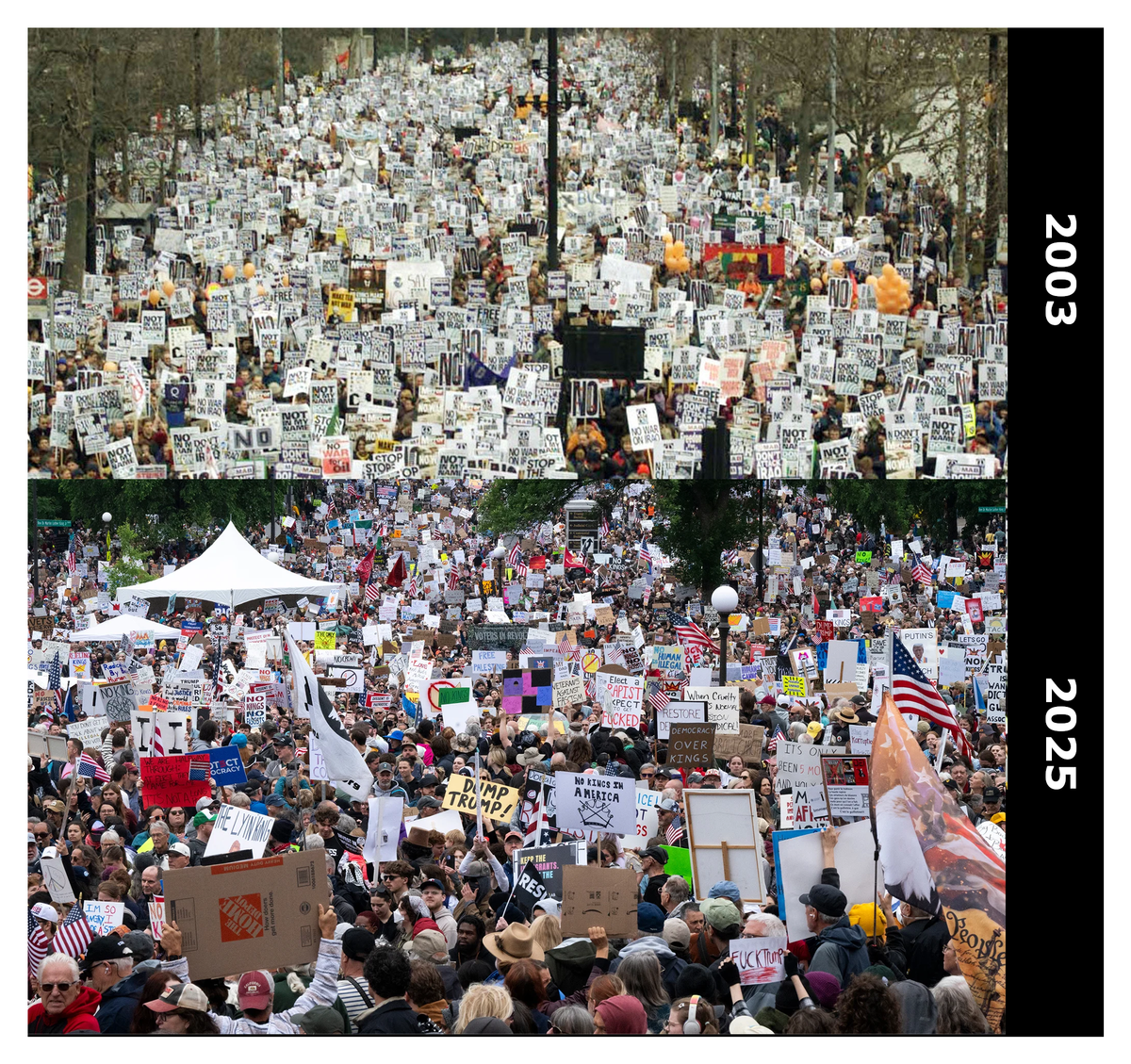
This overlaps with what we've seen since the second election of Trump by groups like Indivisible, 50501, and similar big tent liberal organizations who have called the massive No Kings rallies and marches sold as ways to fight fascism while Democratic Party electeds take to stages to rally the masses to... well, I'm not sure actually. It's not that any of this is all terrible. Entry points or more family safe spaces or easy first things to do are not inherently bad. But that doesn't mean that it's okay to also water down politics in those spaces.
In many ways, this harkens back to the activities that engulfed Minneapolis after the George Floyd uprising. While authoritarian leftist groups held march after march after march (literally several a week for months), electorally-obsessed progressives and even self-identified abolitionists moved into an electoral strategy that focused on both ballot measures and candidates. None of this led to the further abolishment of the police, the carceral system, or the end to the police murdering BIPOC folks. If anything, it contributed to further fragmenting of the Left.
This should not surprise us but in this moment, it is time to question it. The illogical adherence to failed strategy is a century old problem in the US/European Left and many have written about it, challenging us to move past it. Throughout this history of philosophers, essayists, journalists, and academics, Walter Benjamin's concept of left melancholy has become a shared term to encompass this tendency.
Walter Benjamin was a German-Jewish leftist philosopher and writer who died by suicide in 1940 while fleeing the Nazis.[[2]][[3]] His idea, picked up by scholars Stuart Hall and then Wendy Brown, Enzo Traverso, Matt Bloomfield, and more can to help us understand our failings in the past decades so that we may, hopefully, change our approach, our strategies, etc. It does not point to a particular tactic or ideology inherently, but speaks to a stubborn adherence to any political strategy regardless of how much it continues to fail us.
In her essay "Resisting Left Melancholy," Wendy Brown begins with Benjamin, "... left melancholy is Benjamin's unambivalent epithet for the revolutionary hack who is, finally, attached more to a particular political analysis or ideal - even to the failure of that ideal - than to seizing possibilities for radical change in the present." And further, "It signifies, as well, a certain narcissism with regard to one's past political attachments and identity that exceeds any contemporary investment in political mobilization, alliance, or transformation."[[4]] In short, it is to be so tied to your political analysis, belief, strategy, activities, etc. that you will ignore their failure (if not fully embrace said failure) and insist on continuing with such actions and ideas despite what is called for by the present moment in front of you.
Continuing to reflect on Benjamin, Brown writes, "We come to love our left passions and reasons, our left analyses and convictions, more than we love the existing world that we presumably seek to alter with these terms or the future that would be aligned with them."[[5]] More than ever, how odd to consider that the broader western Left (let alone those of us who have fought and died in Minneapolis for our neighbors and for our city), would choose stale left approaches. It is painful and confusing to think that we would chose those attachments over that very world that we love so much that we went out into the well-below freezing temperatures by the tens of thousands to be pepper sprayed and beaten and risk our very lives in order to care for it.
Brown then turns to Stuart Hall. Hall was a Jamaican-British academic and writer who was born in Kingston in 1932 and died in 2014.[[6]] Writing half a century after Benjamin, Hall continued to explore this left melancholy as he looked out at the decimation of the Thatcher-Reagan era. "'Our sectarianism,' Hall argues in the conclusion of The Hard Road to Renewal, not only arises from a defensiveness toward the agendas fixed by now anachronistic political-economic formations (those of the 1930s and of 1945) but 'is also due to a certain notion of politics, inhabited not so much as a theory, more as a habit of mind."[[7]]
Habit of mind. Is that what this is? Habit. Is that why we would yet again choose to return to certain left political activities that have failed us so spectacularly? Now we sit another half a century past the apex of Hall's time writing and his experience in Thatcherism. I argue that we are facing the same questions - we have been since before the response to Metro Surge and even before the Trump era's more blatant fascism began tightening its fist around us.
Before ending with her own questions of how we get out from under this melancholy, Brown writes, "If the contemporary Left often clings to the formations and formulations of another epoch, one in which the notion of unified movements, social totalities, and class-based politics appeared to be viable categories of political and theoretical analysis, this means that it literally renders itself a conservative force in history-one that not only misreads the present but installs traditionalism in the very heart of its praxis, in the place where commitment to risk and upheaval belongs."[[8]]
Wendy Brown published this essay in 1999, almost 30 years ago, at a time that, in my experience, there were great attempts at new and different political approaches on the Left. Yet just a few years later, the anti-war movement of the aughts pulled much of the Left back into the very habits that these authors are critiquing. So what can we hear in that critique? We render ourselves a conservative force in history! And, yet, we just walked through great risk and upheaval.
This brings us to this post-Metro Surge moment; one that we could not have manufactured but from where we continue to ask 'what now?'. It moves us to a fork in the road. We have seen electing Democrats does not address the brutality of the ICE deportation and immigration camp machine, does not stop the police from murdering our neighbors, does not house those suffering on the streets of our cities, does not address the climate crisis. After the 2020 uprising and subsequent street battles in the wake of murders of our black community members, no amount of marches or rallies called by authoritarian left groups or non-profits made it stop. Nor did we vote our way to a better world.
Today, in the wake of Metro Surge and the massive movement happening on the Left against fascism, ICE, and much more, we have potential answers (or seeds of answers) for how to overcome a backslide into a melancholic left. In Minneapolis, no one asked nicely of the electeds, 'Could you please stop the mean men?' Regardless of the myriad attempts of local government, non-profits, and the authoritarian left orgs, the vast majority of people who responded to ICE and participated in mutual aid did so through organization; but not an organization. That organizing did not belong to those institutions mentioned above. People did what needed to be done.
In the more recent Hope Without Hope[[9]], Matt Broomfield picks up the thread of left melancholy and how he sees it as it pertains to the western (US and European) Left now, a quarter century after Brown. Notably, he calls out specific sections of the Left's spin on left melancholy as well as overarching failing strategies.
Communists might cling to the imagery of state socialism, perhaps even to apologia for contemporary, authoritarian, client-capitalist regimes from Putin's Russia to Assad's Syria for their nominal opposition to the US or NATO; anarchists to pastoral fantasies that remain an impractical pipe dream; and all of us, most relevantly, to direct-democratic organizational practices and protest tactics that have failed to achieve lasting material change. Multiple recent analyses of the Left's failures over the decade of missing revolutions conclude by pointing to the continued structural role of left melancholy in conditioning our relationship to both street protest and the cyclical boom-and-bust of populist movements.
~
Today, post-surge spectacle* and before the next election, we find ourselves in a similar situation. There are marches and rallies and similar activities begging for scraps of change from the city, county, state. In Minneapolis, we have altered our usual obsession with everyone working to elect progressives - or at least liberals - into a massive push for "democracy defense." As far as I can tell this is a mix of mostly re-purposing rapid response to defend the November elections and also a bit of holding those in government who monitor elections accountable so that they are supposedly legitimate exercises. This does not address that there is not and has never been democracy in the United States (see us being a conservative force). Those touting it have also been exceptionally quiet about the fact that there is no one running worth electing nor that even in the rare times that we have elected rather progressive politicians into office, the status quo has not changed.
The other options being pushed are again either the marches and rallies run by opaque socialist groups called via Facebook/Instagram or cool kid insurrectionist anarchists who don't play nice with others and hold small events on occasion. Even most "direct action" is a form of asking for change and is almost completely divorced from what that term actually means.
Note that at no point have I mentioned strategy. Because there isn't one clearly articulated. The potential exception being that the argument for "democracy defense" read: election defense, is that if people can vote, that will turn the tide against fascism. I have yet to hear what this reasoning is based on (historical examples, how this works given that we voted ourselves into fascism, etc).
How different is this than what just happened when ICE came to town, where there were strategies, tactics, systems, and organization from the block level on up. There was no executive director or socialist chair running anything. There were a few non-profity folks along with more progressive electeds attempting to be in charge but you ask any of the thousands of people who showed up to protect their neighbors, they probably couldn't tell you who most of those people were. Because it was a truly leaderless/leaderful[[10]] movement that was organized, decentralized, and asked no one's permission. People fought ICE because it had to be done. People fed their community because it had to be done. People stood outside schools in five degree below weather because it had to be done.
Let's be clear, it was not perfect. But it could be a game changer. And, yes, it is built on a legacy that predates this past Winter, which is important to understand. But, it still has the potential to be a game changer. If we choose it to be. These two general sets of activities (electoral politics/never-ending marches versus the rapid response and mutual aid networks built in the past 9 months) are in sharp contrast to each other. Now, we've experienced both. So, the question is: which do we choose as we move forward?
We must acknowledge that it's not as easy as just choosing. Primarily because responding and building are two very different practices. Additionally, there are the last few decades of the disintegration of the Left, meaning that people haven't read or studied much of what is possible, they have not experienced more than the norm of demands-based politics, they have never employed the direct democracy and care that explodes in a response to the day-to-day of life. There is also still capitalism - going to work, paying for increasingly expensive basic needs. And there are just so many forces working to pull people back into the politics of demand.† The revolution will not be funded but the counter-revolution has lots of resources.
~
If we are to choose another path, we need to find a way to sustainably and collectively channel the lived experience of doing what needed to be done into the daily directly democratic governance of our neighborhoods and cities. We know how to protest but what we need are long-term collectives based on neighborhood areas or tasks that then create a network of autonomous neighborhood groups themselves nodes across the city. It is the parallel collectives of care, repression resilience, independent technology, and more that can join a web of place-based and skills-based abolitionist self-governance. Potentially, a dual power approach could be of use given Minneapolis' obsession with local elected officials.
Of the many challenges in these ideas is that these spaces need to have a politics without strict ideology. Which is to say they need to take the best from anarchism, the best from socialism, the best from current and historical attempts that sought the same liberatory goals. They must bring neighbors together who often don't share space and time. They must find ways to be welcoming while also having boundaries, agreements, and avoid the "all are welcome here" approach that only creates entry points for liberals and conservatives to co-opt them.
We are trying this in my small neighborhood and it's very challenging and it will take a long time. It is also very joyful and fulfilling. Collective liberation, abolition, resilience - these are not projects of response but long-term building. Reaction must shift to creation - the building of new autonomous structures. I don't have all of the answers nor should any of us pretend that we know exactly what other places need. In the spirit of the Zapatistas, we must build a world of many worlds, all of which are built on care, resilience, and liberation.
If we choose to try this, if we choose to let go of prioritizing another march posted on a billionaire-owned social media platform, abandon giving all of our time to elections that will change little; if we choose to not only get know our neighbors but together take responsibility for our neighborhoods and dare to build together, we may one day look back on melancholic times as a regrettable part of history that we've moved past.
post-surge spectacle
* the spectacle of Metro Surge - of importance in this conversation is that while the horror of Metro Surge is not to be discounted, there have been as many, if not more, people taken by ICE in other places and at other times. this continues while the left melancholic activities discussed here now take priority.
↩️the politics of demand
† the politics of demand is a phrase i often use as a broad description of political activity that is rooted in asking those in power for change. "We demand... no pipeline, no ICE, better healthcare, etc." this is worth a longer critique elsewhere but the basics are that it means that we are not doing for ourselves and we are further entrenching the power dynamic where others control our lives by understanding change as only something they can do.
↩️- Rachel Leingang, "Anti-ICE Organizers Shift Focus to Defend Democracy from Trump Assault," The Guardian, June 28, 2026, https://www.theguardian.com/us-news/2026/jun/28/ice-minnesota-defending-democracy
- "Walter Benjamin—Philosopher, Cultural Critic, and Essayist," Harvard University Press, November 19, 2023, https://www.hup.harvard.edu/features/walter-benjamin-philosopher-cultural-critic-and-essayist
- "Walter Benjamin," Stanford Encyclopedia of Philosophy, December 23, 2025, https://plato.stanford.edu/entries/benjamin/
- Wendy Brown, "Resisting Left Melancholy," boundary 2 26, no. 3 (Autumn 1999): 20, https://www.sas.upenn.edu/~cavitch/pdf-library/Brown_Resisting_Left_Melancholy.pdf?ref=therebuild.ghost.io
- Brown, 21.
- "About Stuart Hall," Stuart Hall Foundation, February 1, 2021, https://www.stuarthallfoundation.org/stuart-hall/
- Brown, 24.
- Brown, 25.
- Matt Broomfield, Hope Without Hope: Rojava and Revolutionary Commitment (AK Press, 2025), 74.
- Margaret Killjoy, "Our Neighbors in Minneapolis," Birds Before the Storm, January 26, 2026, https://margaretkilljoy.substack.com/p/our-neighbors-in-minneapolis
[[1]]: Rachel Leingang, "Anti-ICE Organizers Shift Focus to Defend Democracy from Trump Assault," The Guardian, June 28, 2026, https://www.theguardian.com/us-news/2026/jun/28/ice-minnesota-defending-democracy
[[2]]: "Walter Benjamin—Philosopher, Cultural Critic, and Essayist," Harvard University Press, November 19, 2023, https://www.hup.harvard.edu/features/walter-benjamin-philosopher-cultural-critic-and-essayist
[[3]]: "Walter Benjamin," Stanford Encyclopedia of Philosophy, December 23, 2025, https://plato.stanford.edu/entries/benjamin/
[[4]]: Wendy Brown, "Resisting Left Melancholy," boundary 2 26, no. 3 (Autumn 1999): 20, https://www.sas.upenn.edu/~cavitch/pdf-library/Brown_Resisting_Left_Melancholy.pdf
[[5]]: Wendy Brown, "Resisting Left Melancholy," boundary 2 26, no. 3 (Autumn 1999): 21, https://www.sas.upenn.edu/~cavitch/pdf-library/Brown_Resisting_Left_Melancholy.pdf
[[6]]: "About Stuart Hall," Stuart Hall Foundation, February 1, 2021, https://www.stuarthallfoundation.org/stuart-hall/
[[7]]: Wendy Brown, "Resisting Left Melancholy," boundary 2 26, no. 3 (Autumn 1999): 24, https://www.sas.upenn.edu/~cavitch/pdf-library/Brown_Resisting_Left_Melancholy.pdf
[[8]]: Wendy Brown, "Resisting Left Melancholy," boundary 2 26, no. 3 (Autumn 1999): 25, https://www.sas.upenn.edu/~cavitch/pdf-library/Brown_Resisting_Left_Melancholy.pdf
[[9]]: Matt Broomfield, Hope Without Hope: Rojava and Revolutionary Commitment (AK Press, 2025), 74. https://www.akpress.org/hope-without-hope.html
[[10]]: Margaret Killjoy, "Our Neighbors in Minneapolis," Birds Before the Storm, January 26, 2026, https://margaretkilljoy.substack.com/p/our-neighbors-in-minneapolis